Let’s Take A Closer Look…Part II
Introduction to Building Performance, it’s a thing…
Note: read ‘Part I’ of this story in last week’s post for more context on this week’s post.
The next chapter of my experience found me sitting across the table from two brothers in an unassuming office interviewing for an “insulation installer” job I had found posted on Craigslist. I had very limited experience with insulation, but I understood enough about being on a construction site as part of a crew and I had confidence in my ability to learn quickly anything I didn’t if I was hired. As it turned out, I was coming in at the very beginning of their endeavor. They were carpenters and general contractors who were now starting a “weatherization” company to take advantage of a weatherization assistance program (WAP) created by newly enacted legislation that required utility companies to provide their customers with “no cost” energy audits, lighting upgrades, and air sealing as well as tax rebates for insulation upgrades. I didn’t know it at the time, but this was the beginning of my exposure to the world of building performance and a path that I’ve been on ever since. I used my prior experience to become a productive crew member and was soon offered the opportunity to receive additional training and certification to become a crew leader. Since I already had great past examples of good leaders, I thought I knew how I should go about it. What I didn’t know was that I really enjoyed teaching skills to others and seeing them succeed and I still had a lot to learn about the ‘soft skills’ needed to be effective as a teacher and leader.
Over the course of about two years, that company went from a small family operation with two employees to the premier weatherization company in their service area with about 40 employees, four work crews, an administrative office suite and warehouse with service department and a high-performance new home/deep energy retrofit construction wing. I trained every new crew member that was hired and each of the new crew leaders as they were ready. I helped to create the role of Quality Control Manager for the service department overseeing all aspects of production and each of the four crews. I also was able to attend many trainings, seminars and industry conventions that accelerated and broadened my knowledge in the field.
I learned so much from this experience including:
· How a building works by testing and improving hundreds of homes a year
· How to communicate and teach building performance concepts to a homeowner, a new hire with no experience, a seasoned crew member ready for more knowledge, and other tradespeople
· How a weatherization assistance program works
· How a weatherization company works and the challenges they face
· The role that emerging technology plays in the trade and what is possible, as well as what is considered “common practice”, “best practice”, and the difference between them.
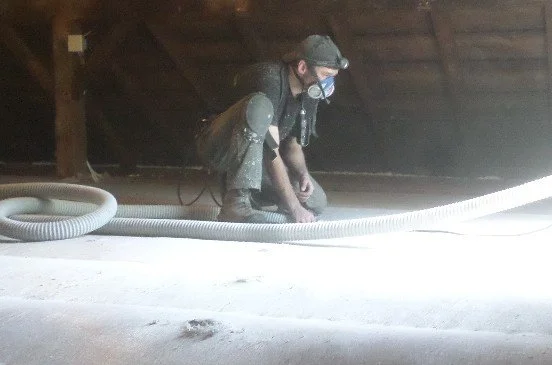
Dense Pack Cellulose in attic floor in a pre-1900 home, 2014
I learned that changing how a building functions in one aspect can affect how it functions in other aspects. For example, by ‘tightening’ the building enclosure through air sealing and insulation to improve energy efficiency, you also could cause health or safety issues for the occupants inside. While a less drafty home was more comfortable and less expensive to heat and cool, it was also more susceptible to indoor air pollutants and moisture problems. This means that you must take all these aspects into account before implementing a change so that you don’t create a negative impact with your ‘improvements’. I found this idea fascinating at the time and the challenge of designing healthy and efficient homes had me hooked.
I was and continue to be amazed by how little of this idea is understood by the public (most of us live in or occupy a building for a large part of our lives) and critically, builders, contractors and tradespeople who make changes to our buildings every day without an understanding of the potential consequences. I knew that I wanted to work to change this. To help educate building owners and the trade’s on how to make better, healthier buildings.
By doing this work in the Northeastern United States, I was working primarily in single family homes built between 1850 and 2000. I got to see how old homes were built vs more modern construction (post 1950) methods. I love prewar era homes that were built using classical architectural guidelines and principles and the beauty that results from that structure, but they were not made with modern energy use or health standards in mind, and the idea of retrofitting them to meet modern performance standards while maintaining their inherent original beauty is a passion of mine. I also think that it aligns well with the principles of ‘reduce, reuse, and recycle’.
I look back on this point in my life and remember feeling that I could see a path forward to success and that I could be successful doing something meaningful and that I enjoyed. As life will often do, it through me a curve ball. I met someone I wanted to share life with, and she was moving to North Carolina for graduate school. So, I went too.