Let’s Take A Closer Look…Part III
Building Science, Southern Style and setbacks can be opportunities…
Note: read ‘Part I and Part II’ of this story in prior posts if you want more context for this week’s post.
After relocating and getting to know my new, I applied for and accepted a position with an insulation/weatherization company with good reviews that was near my home. They had only one position listed and it was for an entry-level installer. I felt that I was overqualified for the position, but the company seemed like what I was looking for, and I liked that it was a short commute. I figured that my experience and work ethic would lead to greater responsibility and opportunity with time and, I needed the work.
The position was offered to me within 30 minutes of submitting my application. At the time, I was proud of this. In hindsight, it was a red flag that I missed. I started to get the sense that this job would be different from my last one almost immediately. Once entering the service department, disorganization was everywhere. No one seemed to be in charge, no one was expecting me on my first day and there was no process for on boarding. I had grown used to mornings at my last company where the careful process of operations had ingrained itself in every detail: the shop was clean and organized from the night before, employees were arriving on time and knew what to do and the production manager was always there for a brief department wide meeting on the shop floor. We were all on the same page. The efficiency of the operation meant that any problems could be addressed easily, and solutions communicated to every member of the team. In short, company culture was fostered and central to how we operated. This was the opposite of that and honestly, the difference was striking.
The short version of the story is that I spent several months trying to figure out what needed to happen to get the operations standards up to where I thought they should be, talking to the crew members and management, and observing everything and trying to determine if change was even possible. I had the opportunity to learn more about HVAC systems and especially forced air systems and central air conditioning which were less common in the Northeast at the time. I saw how duct systems and equipment were removed and replaced. I learned how to be a duct mechanic and the practical challenges of that work. I also learned about open-vented crawl spaces. Which are an extremely prevalent design strategy in the Southeast. This design strategy comes with a low initial cost but creates real long-term durability issues for the structure as well as significant hurdles to achieving a healthy building for the occupants. Hence, the closed crawl space design. Upgrading to a closed design from an open one was a big part of the available work and I began to learn about this process. One problem with open-vented crawl space design is that it is prone to mold growth. I was exposed to how this issue is sometimes addressed. I also got first-hand experience installing spray foam insulation and the challenges and risks of using this product. I did the work of the installer every day and found that just like doing weatherization in the North, even under the best conditions, the work is difficult and demanding and to get real results, you have to be dedicated to doing good work in spite of adversity and you have to have a good system with an strong support team. This was not what was happening at this company.
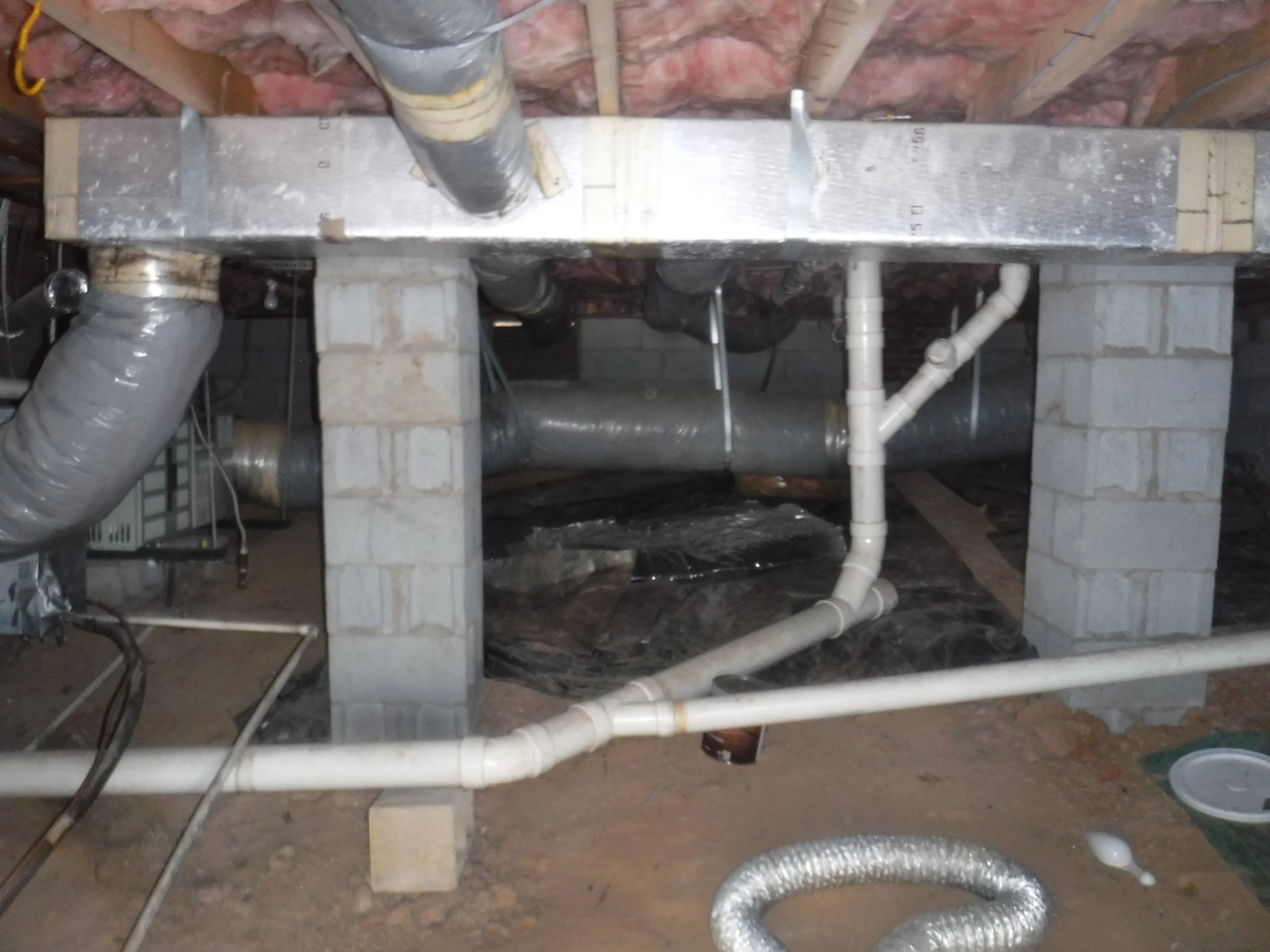
HVAC and Air Duct Replacement Project in a Moldy, Open-Vented Crawl Space
I want to be clear here because it is not my intent to be disparaging; this was a long time ago and does not necessarily reflect who that company is now. I don’t know anything about their operations today. It should also be said that I don’t know the whole story about how they got to where they were when I was hired and although it was not a good fit for me, I am still grateful that they gave me an opportunity at the time. I’m including this part of the story because I think it was an important step in my journey and by sharing the experience and my thoughts about it, there may be something of value for someone else in a similar situation.
What I realized was that for several reasons, there was no buy-in from anyone there. No pride in the work they were doing. That anyone who had these qualities had left or were on their way out the door. Management had either stopped caring or had even bigger problems to worry about. I started to feel like I was on a sinking ship. I’ve always enjoyed a challenge, I don’t like walking away just because something is difficult, and I needed the work. So, I kept working on a solution, thinking about bigger picture stuff as well as the little details. I cleaned trucks, swept up the shop, looked for opportunities to teach skills. I tried to lead by example. But soon something else became apparent to me: I had ethical concerns that I just could not ignore. Decisions were being made that put the health and safety of employees and customers at risk. And in addition, there were work practices that were acceptable to the company that I simply was not comfortable with being involved with. When I brought my concerns to management, sometimes they made efforts to improve, but mostly, they weren’t willing (or able) to make significant changes. I knew that it was time to move on. I did my best to leave the right way. I gave my notice and left on good terms. When I look back, I know I made the right decision to leave, but it still doesn’t feel good.
I thought about leaving this experience out, but I realize that it was an important moment in my career. I learned what bad company culture looks like firsthand, how it can manifest, what the consequences can be. I learned that even the best installer with the best intentions can’t deliver good results consistently without the support of a good organization behind them. I learned that some things can’t be fixed and sometimes you just have to walk away. I learned that while first impressions are important, it’s a good idea to take a moment to consider your own perspective bias before you make a decision. I learned that sticking to your principles matters a lot. Even though I didn’t have another opportunity lined up and it was a risk, I knew it was the right decision for me at the time. I still wish it could have turned out differently, but it opened the door to my next opportunity…
Have you found yourself trying to find the right contractor for your home and not sure how to decide? Seeing what feels like a problem but not sure how to address it so you take a best guess and start somewhere? Have you hired someone and now you feel like they didn’t deliver the results you expected? Here at North Star Environmental Building Performance LLC, we can help you by correctly diagnosing the problem and by detailing a solution that will work for you. We can also help you decide which contractor will be the best fit for your project as well as ensure that you get the results you expect from them.
Reach out today, we’re excited to hear about your next project!